Welcome to the
Ache Lab
We study neuronal mechanisms enabling flexible information processing and action selection in the nervous system.
Research
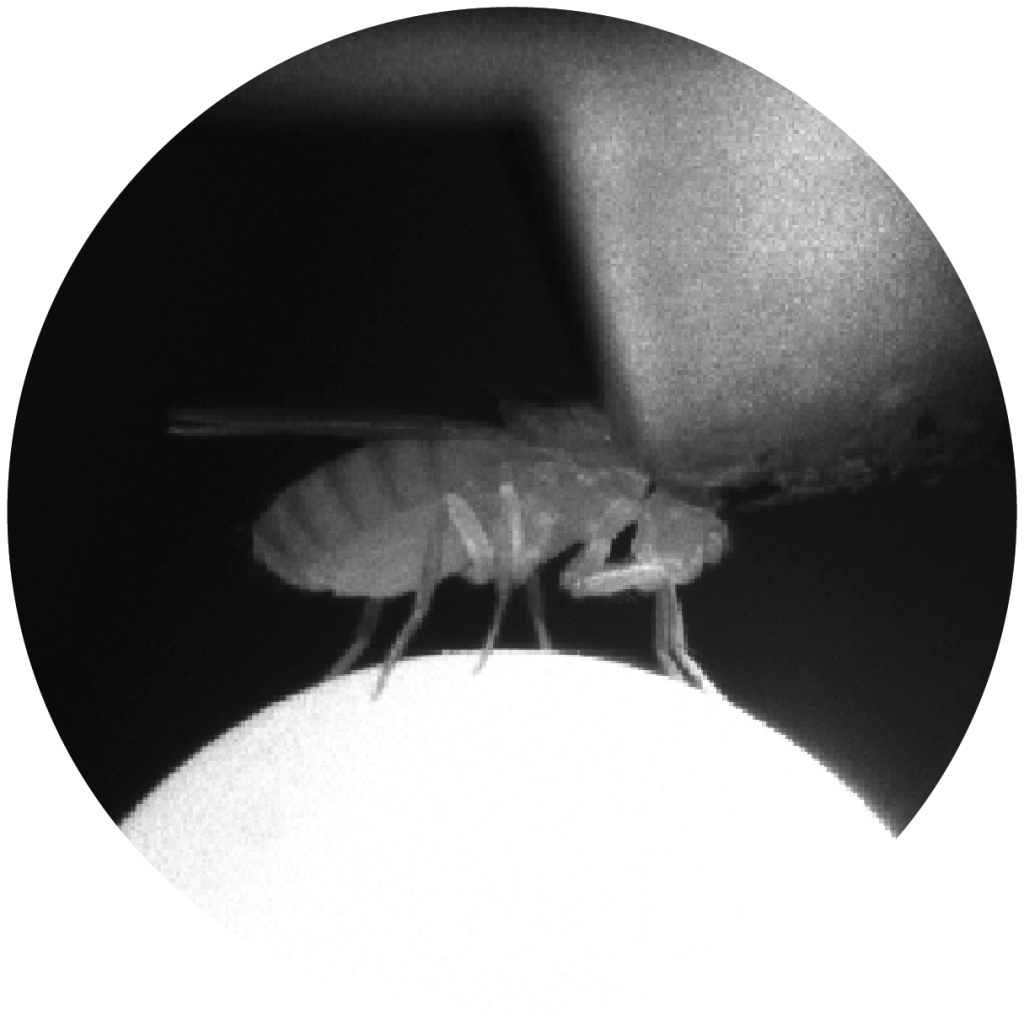
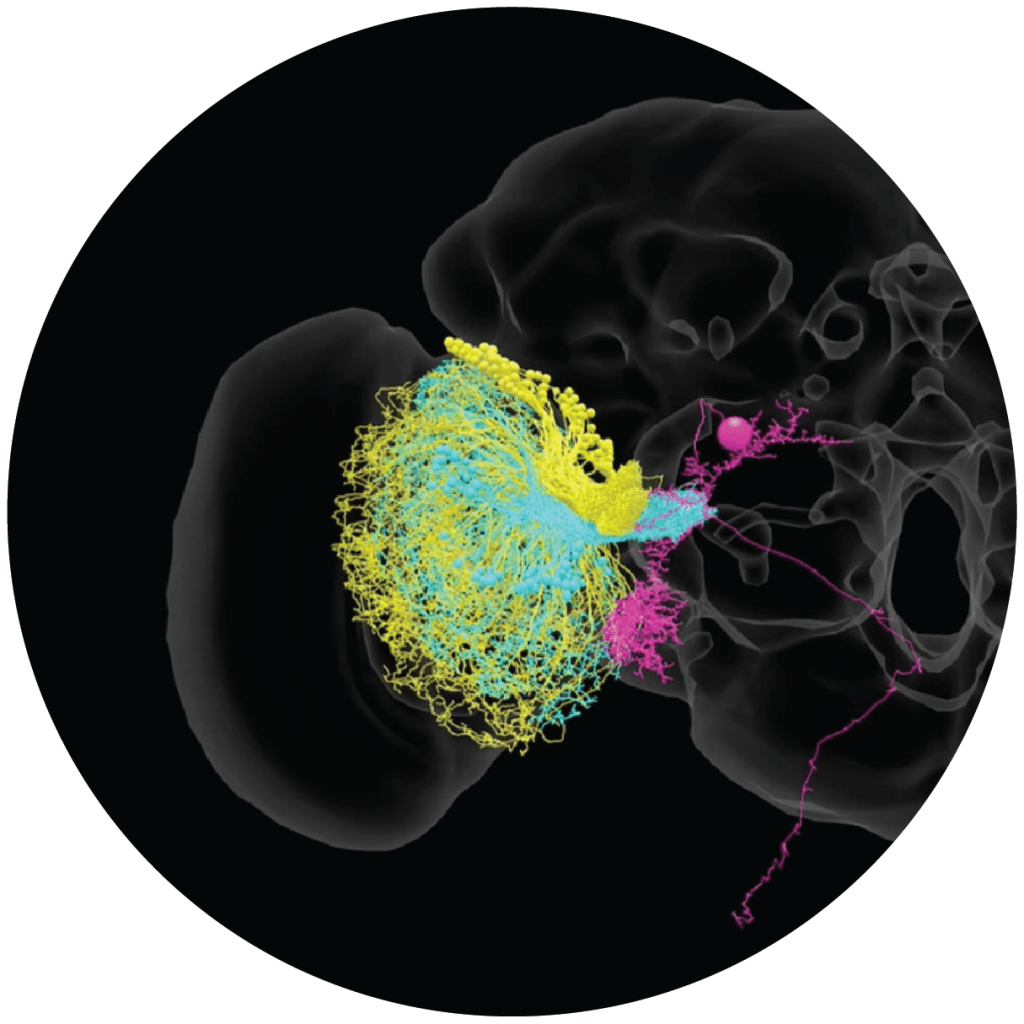
We study the neuronal control of flexible behavior in the fruit fly, Drosophila. In one line of research, we dissect sensorimotor circuits controlling different aspects of walking and flight. In a complementary line of research, we investigate modulatory circuits that give rise to flexibility in neuronal information processing. Here, we currently focus on the insulinergic system to better understand how internal states shape behavior and vice versa.
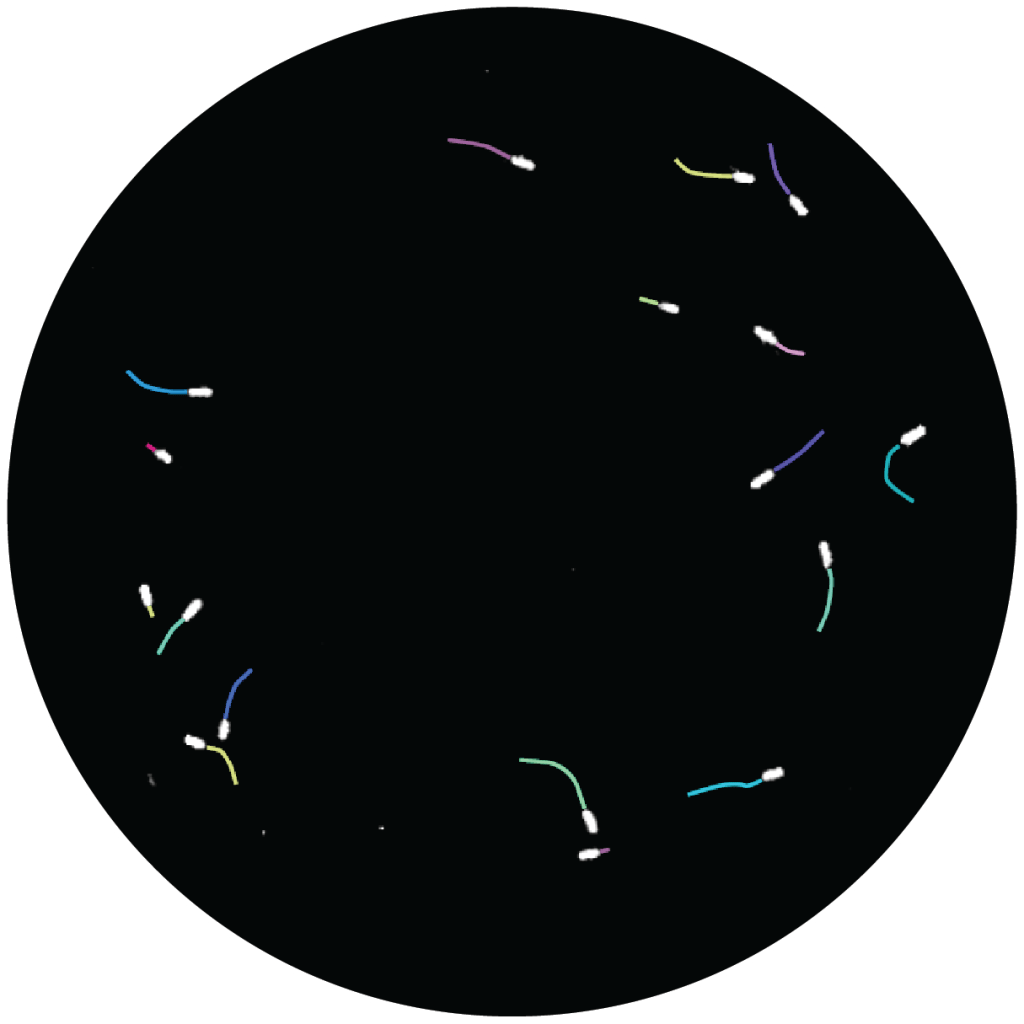
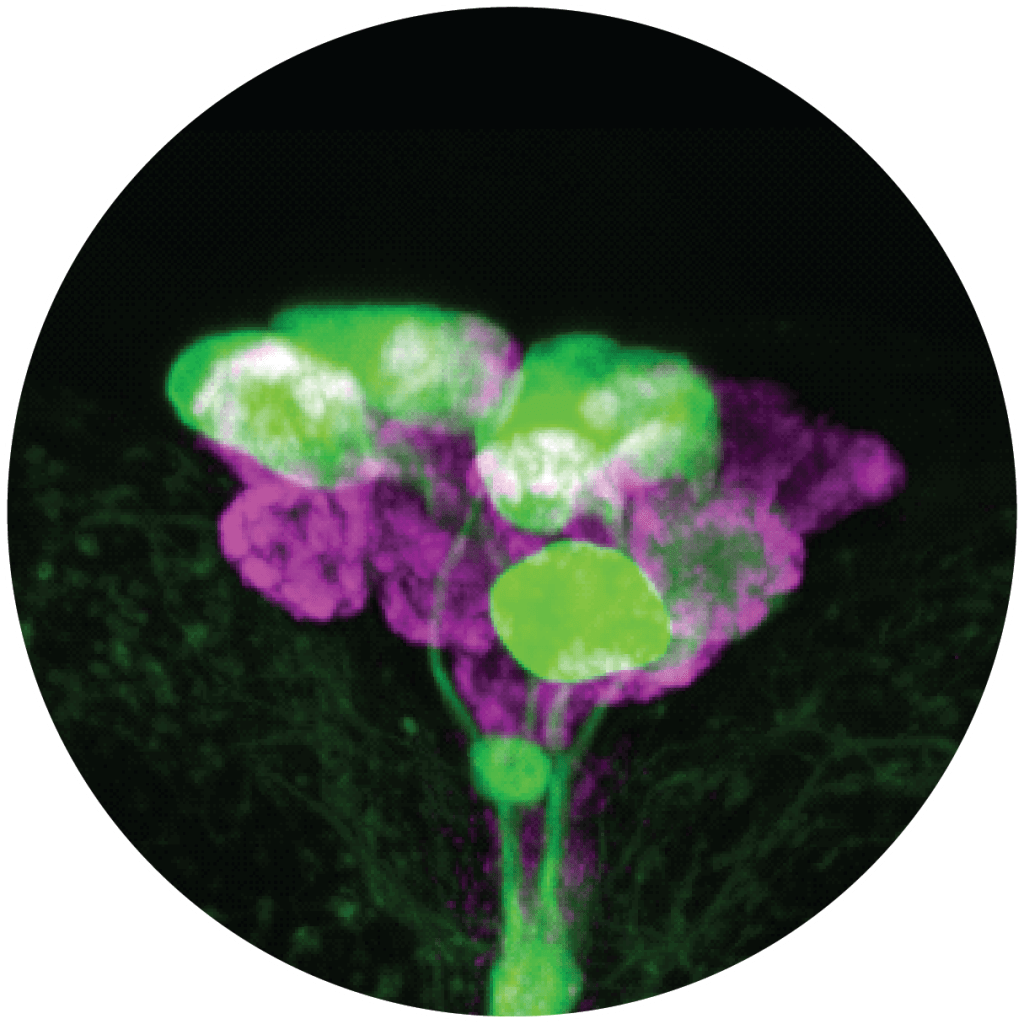
We use a variety of techniques, from in-vivo patch-clamp recordings and calcium imaging in behaving flies over automated behavioral analysis to electron microscopy-based connectomics approaches.
Learn about our international collaborations
Büschges Lab (University of Cologne)
We are closely collaborating with the Büschges Lab on descending control of locomotion in Drosophila within our C3NS NeuroNex project.
Haluk Lacin, PhD (Washington University in St. Louis)
We are collaborating with Haluk on a project that involves chewing lots of food (preferably Iskender).
Carlos Ribeiro, PhD (Champalimaud Centre for the Unknown)
We are collaborating with Carlos and his team to better understand how sensory inputs converge onto modulatory networks that set and respond to metabolic state changes in the context of food-sensing.
Prof. Sabine Fischer (CCTB, Würzburg) and Lorenzo Fontolan, PhD (HHMI, Janelia Research Campus)
Sabine and Lorenzo are modeling experts and enthusiasts, who are helping us build theoretical models of the modulatory circuits we are characterizing electrophysiologically.
Prof. Tanja Godenschwege (Florida Atlantic University)
Tanja is a visiting scientist with the lab and together we are working on some nifty molecular signaling pathways.
Gwyneth M. Card, PhD (HHMI, Janelia Research Campus)
We are working on characterizing the networks underlying landing responses in Drosophila with Jan’s postdoc advisor, Gwyneth Card. This project is supported by a Janelia visitor project grant.
Our research is generously funded by the DFG’s Emmy Noether and Walter Benjamin Program, the international DFG/NSF NeuroNex Program, and the European Union’s Marie Sklodowska-Curie Actions.
Team

Jan M. Ache
Group Leader
Learn more
jan.ache(at)uni-wuerzburg.de
Jan is an Emmy Noether fellow and the PI of the Ache lab. He holds a BSc in Biology and an MSc in Neuroscience from the University of Cologne, and a PhD in Neuroscience from the University of Bielefeld. For his postdoc, Jan worked with Gwyneth Card at HHMI’s Janelia Research Campus.
Among other things, Jan has taught at the MBL in Woods Hole, won several awards at FameLab science slams, is a PI within the C3NS NeuroNex network, and enjoys patching neurons whenever he gets the chance.

Chris J. Dallmann
Postdoctoral Fellow
Learn more
chris.dallmann(at)uni-wuerzburg.de
Chris is a Marie Sklodowska-Curie Fellow in the lab. He studies how circuits in the Drosophila ventral nerve cord, the analog of the spinal cord, translate movement instructions from the brain into leg movements during walking.
Chris has a BSc in Bio-inspired Engineering from the University of Applied Sciences Bremen, and a MSc in Neurobiology and PhD in Neuroscience from Bielefeld University. Prior to joining the lab, Chris was a DFG Postdoctoral Fellow in the Tuthill Lab at the University of Washington in Seattle.
Learn more at https://www.chrisjdallmann.com

Sander Liessem
Postdoctoral Fellow
Learn more
sander.liessem(at)uni-wuerzburg.de
Sander studies how premotor circuits in the Drosophila brain integrate sensory feedback and are modulated by the behavioral state.
Sander pursued his postgraduate studies at the University of Cologne, where he qualified for the fast-track Masters/Doctoral program. He received his PhD in Neurobiology in Ansgar Büschges’ and Reinhard Predel’s labs. His doctoral research focused on the identification and role of neuropeptides in insect motor control.
Martina Held
Postdoctoral Fellow
Learn more
martina.held(at)uni-wuerzburg.de
Martina studies the modulation of insulin producing cells in the Drosophila brain.
Martina holds a BSc in Biology and a MSc in Organismic Biology from the University of Marburg. She received her PhD in Neurobiology from the University of Marburg. Her doctoral research focused on anatomical and physiological investigations of the sky-compass system in honeybees and desert locusts.
Mert Erginkaya
Postdoctoral Fellow
Learn more
mert.erginkaya(at)uni-wuerzburg.de
Mert studies how premotor circuits in the Drosophila brain integrate sensory feedback and are modulated by the behavioral state.
After completing his BSc in Molecular Biology and Genetics at Boğaziçi University in Istanbul, Mert transitioned to Lisbon to pursue his PhD in neuroscience under the supervision of Eugenia Chiappe at Champalimaud Research. His doctoral research centered on the identification and characterization of visual feedback premotor circuits in the Drosophila brain.

Fathima M. Iqbal
PhD Student
Learn more
fathima.iqbal(at)uni-wuerzburg.de
Fathima identifies and characterizes neurons in the Drosophila brain that control different aspects of locomotion.
Fathima hails from the southern part of India. She holds a BSc in Biotechnology from Mahatma Gandhi University, Kerala, and a MSc in Biotechnology from the Cochin University of Science and Technology. Fathima completed her MSc project with the guidance of Dr. Gaurav Das, National Center for Cell Science (NCCS), Pune. She continued the work at the NCCS with the same group before moving to Würzburg to embark on her PhD project.

Federico Milani
PhD Student
Learn more
federico.cascino-milani(at)uni-wuerzburg.de
Federico develops computational models to understand how neuromodulators in the Drosophila brain act together to mediate flexible sensorimotor processing and adjust the fly’s metabolism.
Federico holds a BSc in Natural Sciences and a MSc in Neurobiology from La Sapienza-University of Rome, Italy. He also attended a one-year master course at the Advanced School in Artificial Intelligence (AS-AI) held by the Institute of Cognitive Sciences and Technologies, National Research Council (CNR-ISTC) of Rome.

Sirin Liebscher
PhD Student
Learn more
sirin.liebscher(at)uni-wuerzburg.de
Sirin studies how premotor circuits in the Drosophila brain integrate sensory feedback and are modulated by the behavioral state.
Sirin’s academic journey began at the University of Münster, where she earned a BSc in Biosciences. Her undergraduate research in Ralf Stanewsky’s lab focused on circadian rhythms in Drosophila. Subsequently, she moved to Leipzig for postgraduate studies, obtaining a MSc in Neurobiology and Behavior. For her Master’s thesis with Andreas Thum, Sirin focused on anaesthesia-resistant memory in Drosophila larvae.
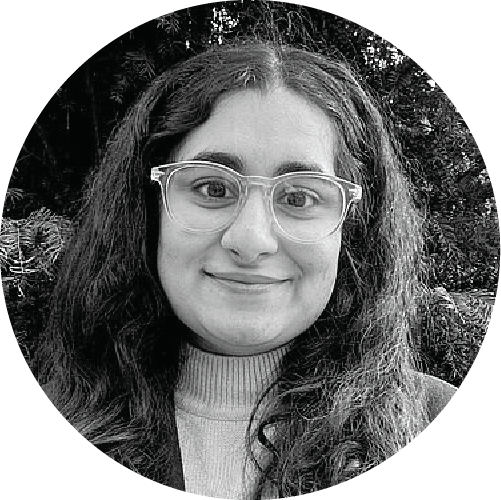
Romita Trehan
PhD Student
Learn more
romita.trehan(at)uni-wuerzburg.de
Romita is jointly advised with Hannah Haberkern. She studies the interplay between sensory perception and decision-making in Drosophila.
Romita holds a MSc in Applied Biosciences and Biotechnology from Imperial College London, where she did her thesis in the Gilestro Lab, investigating the evolution of sleep homeostasis in different species of Drosophila. She also has experience working in science communication, outreach, and citizen sciences at Earthwatch Europe and the CSIR Institute of Microbial Technology.
M.Sc. Students
Edda Sauer
Hannah Volk
Xu ‘Aaron’ Yunfeng
Research Assistants
Hannah Volk
Alumni
Rituja Bisen (PhD student, now postdoc at MPI for Metabolism Research)
Stefan Dahlhoff (Postdoc)
Edda Sauer (BSc Student)
Sophie Dejosez (BSc Student)
Mia Vögtle (BSc Student)
Hannah Soyka (MSc Student, now PhD Student at University of Basel)
Hannah Volk (BSc Student)
Isabella Balles (MSc Student, now PhD Student at Charité Berlin)
Aleyna Meric (MSc Student, now PhD Student at University of Göttingen)
Alexandra Keller (BSc Student)
Nicole Enslinger (BSc Student)
Publications
Dallmann CJ, Mukthar Iqbal F, Liebscher S, Erginkaya M, Liessem S, Sauer EL, Soyka H, Cascino-Milani F, Goldammer J, Ito K, Ache JM (2026). A dedicated brain circuit controls forward walking in Drosophila. bioRxiv. PDF
Bisen RS, Liessem S, Held M, Ache JM (2026). The role of insulin and octopamin in regulating energy homeostasis and locomotion in insects. Current Opinion in Insect Science. PDF
Liessem S*, Asinof SK*, Nern A, Sumathipala M, Rogers E, Erginkaya M, Dallmann CJ, Card GM, Ache JM (2025). Parallel neuronal ensembles control behavior across sensorimotor levels in Drosophila. *Co-first authors. bioRxiv. PDF
Dahlhoff S*, Liessem S*, Iqbal FM, Palacios-Munoz A, Cascino-Milani F, Erginkaya M, Diniz AM, Gorostiza EA, Büschges A, Clemens J, and Ache JM (2025). Control of walking direction by descending and dopaminergic neurons in Drosophila. *Co-first authors. bioRxiv. PDF
König MA, Kucharowski N, Dancourt Ramos DP, Soyka H, Wunderling K, Bülow TR, Yaghmour MH, Thiele C, Ache JM, Kuerschner L, Bülow MH (2025). Insulin-like peptide secretion is mediated by peroxisome-Golgi interplay. bioRxiv. PDF
Büschges A, and Ache JM (2025). Motor control on the move: From insights in insects to general mechanisms. Physiological Reviews. PDF
Learn more
In this review, Jan and Ansgar Büschges summarize essential discoveries and current developments in insect motor control, and discuss how these insights can be applied to derive fundamental principles that govern the neuronal control of movement across species.
Held M, Bisen RS, Zandawala M, Chockley AS, Balles IS, Hilpert S, Liessem S, Cascino-Milani F, and Ache JM (2025). Aminergic and peptidergic modulation of Insulin-Producing Cells in Drosophila. eLife. PDF
Learn more
This is the third manuscript in our IPC modulation Triptychon, in which we investigated how IPCs are modulated by other populations of modulatory neurons. This paper combines a number of methods to unravel IPC modulation on different levels. We demonstrate how IPC activity is shifted by modulatory inputs and that the IPCs are a heterogeneous population. Check out the eLife press release here: https://tinyurl.com/36ekwrcd
Bisen RS, Iqbal FM, Cascino-Milani F, Bockemühl T, and Ache JM (2025). Nutritional state-dependent modulation of Insulin-Producing Cells in Drosophila. eLife. PDF
Learn more
This is the second manuscript in our IPC modulation Triptychon, in which we tackled the question how IPCs are modulated by the nutritional state and how they affect foraging behavior. Among other things, we demonstrate that Drosophila IPCs display an “incretin effect”, in that they respond strongly to glucose ingestion but not perfusion. This is a fundamental property of the modulation of insulin release in vertebrate species, and opens the door for us to investigate this crucial metabolic principle using our in-vivo physiology approaches in flies.
Erginkaya M, and Ache JM (2024). Neuroscience: A big step forward for motor control in Drosophila. Current Biology. PDF
Learn more
In this invited Dispatch, we discuss recent connectomes of the Drosophila VNC (in particular, the connectome of the Female Adult Nerve Cord, FANC) and how they will help the community unravel the organization of motor control networks.
Liessem S, Held M, Bisen RS, Haberkern H, Lacin H, Bockemühl T, and Ache JM (2023). Behavioral state-dependent modulation of Insulin-Producing Cells in Drosophila. Current Biology. PDF
Learn more
This is the first manuscript in our IPC modulation Triptychon, in which we quantified the behavioral state-dependent modulation of IPCs. The core take home message here is that IPCs are inhibited during locomotion, as demonstrated for flight, spontaneous walking, and optogenetically controlled backward walking. Importantly, we show that IPC modulation is predictive, in that IPCs are also inhibited upon optogenetic activation of motor networks ex-vivo, in the absence of any actual muscle contractions or movements.
Contact
jan.ache(at)uni-wuerzburg.de
Biocenter
Neurobiology and Genetics
University of Würzburg
Am Hubland, 97074 Würzburg, Germany
 Ache Lab